


Phytoplankton Dosing for Reef Tanks: Getting It Right (Without Guesswork)
Phytoplankton Dosing for Reef Tanks:
Getting It Right (Without Guesswork)
As a reminder, I write these articles to help you avoid the loops I got stuck in. If I missed a nuance you’ve wrestled with, let me know. We’re all learning. I have loved phytoplankton for 25 years. I have cultured phytoplankton professionally and for fun and I hope this guide will help you on your journey to an even better reef tank.
-Tamara
This is the first article in my new Phytoplankton series stay tuned for future articles when we dive deeper into culturing techniques.
Article 1: (This one) How to Dose Phyto
Article 2: How to Select the Correct Phytoplankton for Your Reef
Introduction
I love when a topic comes up so often in the forums that it demands a clear, no-nonsense guide. This one is for everyone who’s ever stared at a bottle of green water and wondered, "How much of this stuff am I supposed to use?"
Let’s start with the truth: most reefers dose phytoplankton like they’re feeding an invisible pet. A little here, a splash there, maybe a double dose when feeling optimistic. And sure—it won’t crash your tank (probably). But if you’re chasing stronger colors, happier corals, and cleaner water, it’s time to get intentional about how and why you’re dosing phyto.
This article kicks off a five-part series all about mastering phytoplankton for reef tanks. In this first part, we’re diving into dosing—the when, why, and how much. In the next parts, we’ll cover how to choose the right species, how to culture the top three strains at home, and how to avoid the kind of mistakes that turn a bottle of green water into a science experiment gone wrong.
Reader Promise
You’re about to get a complete, practical guide to dosing phytoplankton. We’ll move from what it actually does in your tank, to choosing the right product, all the way to building a dosing schedule you can adjust with confidence—not superstition. I’ll keep the science relevant, the steps actionable, and the tone honest. My goal isn’t to just add a bottle; it’s to intentionally feed a part of your ecosystem you can’t easily see. If this feels like a lot, take a breath. You’re learning, and that’s what matters right now.
The Golden Rules of Phytoplankton Dosing
- Trends Matter, Not a Regiment: Your tank’s response is more important than sticking rigidly to a chart. Watch, then adjust.
- Feed the System, Not Just the Tank: You’re dosing for copepods, clams, and sponges as much as for corals.
- Start Low, Go Slow: It’s easier to add more later than to clean up a bacterial bloom from overdoing it.
- Consistency Beats Heroics: Small, regular doses build stability better than occasional large ones.
- Log It or Lose It: If you don’t write down what you did and what you saw, you’re guessing next week.
Do You Actually Need to Dose Phytoplankton?
Let’s be clear: countless beautiful reefs thrive without ever seeing a drop of phyto. It’s not a foundational parameter like alkalinity or temperature. Whether you need it depends entirely on what you’re trying to accomplish.
You likely DO NOT need to dose phytoplankton if you are:
-
A beginner: Focus your energy and budget on nailing stability in salinity, temperature, and major elements.
-
Running a lightly stocked or fish-only system: Your food inputs are likely sufficient.
-
Battling chronic high nutrients or algae: Adding phyto can be like pouring gasoline on that fire. Solve the export problem first.
-
On a tight budget: The money is better spent on a quality protein skimmer or an auto-top off.
Phytoplankton becomes a powerful tool if you are:
-
Supporting a population of filter feeders: Clams, non-photosynthetic gorgonians, feather dusters, and sponges will show clear, direct benefits.
-
Trying to boost pod populations: For mandarins, wrasses, or just a richer food web, phyto is the fuel that drives reproduction.
-
Chasing ultra-low, stable nutrients: Used intentionally, it can provide a consistent, consumable nutrient source that discourages nuisance algae boom/bust cycles.
-
A tinkerer who loves ecosystem building: If you enjoy cultivating every level of the food web, this is a deeply satisfying piece of the puzzle.
The Bottom Line:
View phytoplankton not as a coral food, but as a way to support the entire foood chain living in your tank. It’s for feeding the tiny creatures that then feed your corals and fish. Start without it. Add it with a clear purpose.
Phytoplankton 101: What You’re Actually Dosing
Forget the textbook definition. In practical terms, phytoplankton in your reef tank is microscopic algae that acts as the primary fuel for your tank’s hidden workforce.
Think of your tank in three layers:
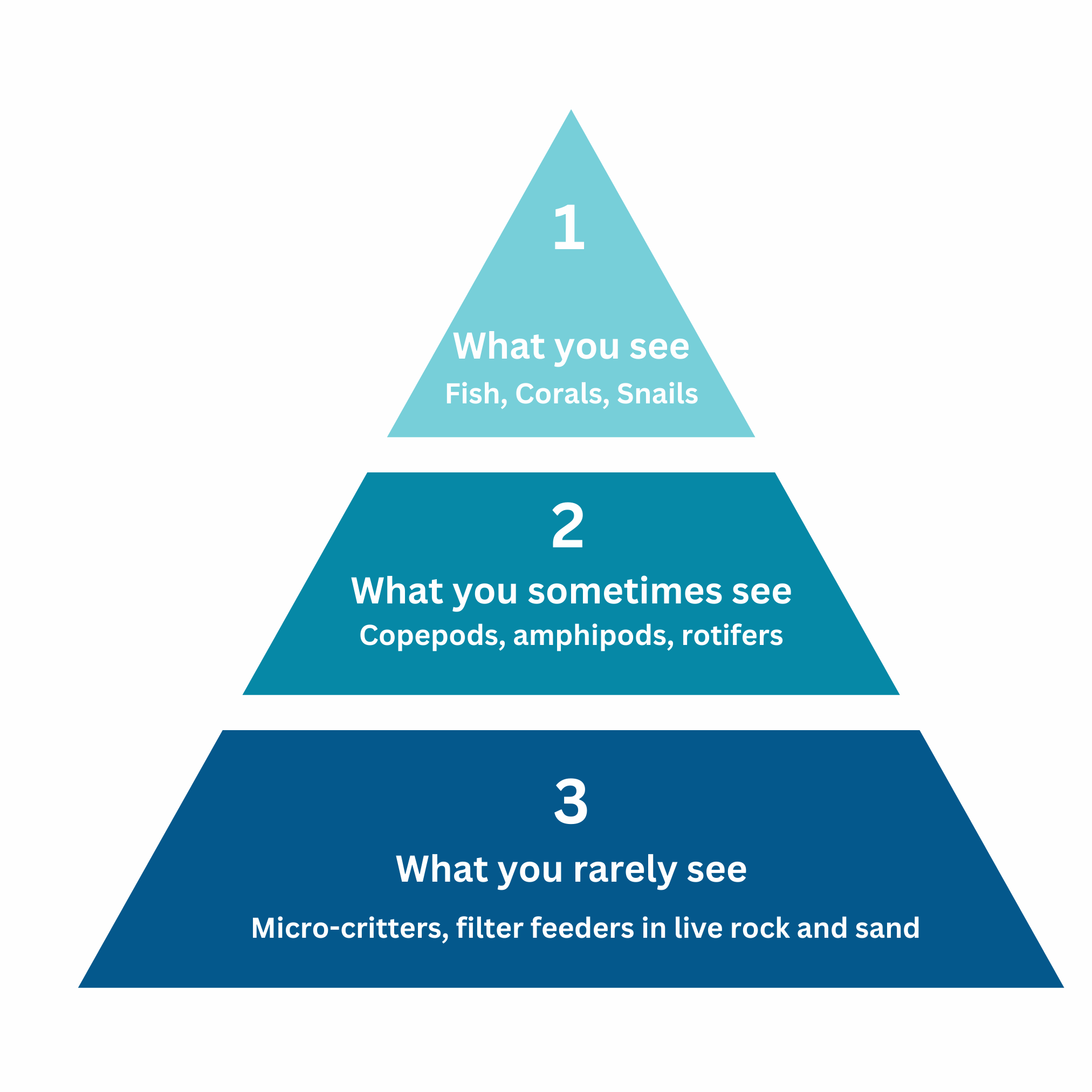
Phytoplankton feeds Layer 3, which in turn feeds Layer 2, which ultimately feeds Layer 1. When you dose phyto, you’re investing at the base of the food pyramid.
What’s In a Bottle? Key Terms Decoded:
-
Live vs. Concentrated vs. Preserved: Live is exactly that—living cells that will reproduce in your tank. Concentrated is often live but densely packed; viability varies. Preserved (paste) is dead but nutritionally intact; great for enriching rotifer cultures, but won’t seed your tank with life.
-
Strains: There are a lot of different strains that are sold. These are the most common, but just know there are a lot of other kinds.
-
Nannochloropsis is a hardy, nutritional workhorse.
-
Isochrysis (T-Iso) is smaller, richer in fats, loved by clams and pods.
-
Tetraselmis is mobile and highly palatable. The strain dictates who benefits most.
-
-
Cells/mL: A measure of density. It’s only useful if you know the strain and the product is fresh. A high cell count of old, dying algae isn’t helpful.
Building Your Intentional Dosing Framework
This is where we move from random splashing to a plan. Dosing blindly is like prescribing medicine without a diagnosis. First, we diagnose the goal.
Step 1: Define Your Goal
-
Goal A: “I want more copepods for my mandarin.”
-
Goal B: “I want my maximas and feather dusters to thrive.”
-
Goal C: “I want to smooth out my nitrate/phosphate swings.”
Your goal determines your strain choice and starting dose.
Step 2: Choose Your Strain(s)
-
For Pods & General Food Web: A blend of Isochrysis (nutrition) and Tetraselmis (palatability).
-
For Clams & Filter Feeders: A blend of Isochrysis and Rhodomonas (if you can find it).
-
For System Stability & Rotifer Culturing: Nannochloropsis is the reliable foundation.
Step 3: Calculate Your Starting Dose
For a fresh, live culture of moderate density, this is a safe starting point. Always split your daily total into 2-3 doses if possible.
For General System Support / First-Time Users:
-
Week 1: 0.5 mL per gallon of tank water per day.
-
Week 2: 1.0 mL per gallon per day. Hold and observe.
For Pod-Focused or Filter-Feeder-Heavy Tanks:
-
Week 1: 1.0 mL per gallon per day.
-
Week 2: 2.0 mL per gallon per day. This is often a sweet spot.
Step 4: Coordinate Your Equipment
Phyto is food. Your skimmer and UV sterilizer are designed to remove organics and microbes. They will remove your phyto if you let them. You don't have to do the following but it will allow you to get the most out of the phyto you add to the tank.
-
Protein Skimmer: Put it on a timer to turn off or reduce airflow for 60-90 minutes after each phyto dose.
-
UV Sterilizer: Turn it off for 2-3 hours post-dose.
-
Flow: Ensure you have good circulation when you dose. Don’t pour it into a dead spot.
Step 5: Observe and Adjust Like a Detective
This is the critical part. You are looking for signals.
The Good Signals (Increase or maintain dose):
-
More copepods on the glass at night.
-
Better extension from feather dusters, clams, and sponges.
-
Nitrate and phosphate holding stable at your target range.
The Warning Signals (Decrease dose or pause):
-
Persistent cloudy water or bacterial film.
-
Sudden cyanobacteria outbreaks.
-
Nutrients (nitrate/phosphate) bottoming out to zero.
-
Skimmer going wild for more than a day.
Real-World Dosing Scenarios
- The 40-Gallon Mixed Reef with a Refugium: Goal is pod support. Use a Isochrysis/Tetraselmis blend. Start at 40 mL/day (split AM/PM). Skimmer off for 60 mins post-dose. Expect to see a pod population bump in the display in 10-14 days.
- The 120-Gallon SPS-Dominant with Clams: Goal is filter feeder health. Use an Isochrysis/Rhodomonas blend. Start at 120 mL/day (split into 3-4 micro-doses). UV off for 2 hours. Watch for thicker, more colorful clam mantles and steady nutrient levels.
- The 20-Gallon Nano: Goal is general food web. Start conservatively with Nannochloropsis at 10 mL/day (split AM/PM). Watch water clarity like a hawk; nanos react fast. At the first sign of haze, skip a dose.
Troubleshooting: Reading Your Tank’s Signals
1. “I started dosing and now I have cyano.”
-
-
Likely Cause: You’ve added an organic carbon source (phyto) and your system’s balance is off, or phosphate is bottomed out.
-
Fix: Reduce phyto dose by 50%. Test phosphate; if it’s near zero, feed your fish a bit more or pause carbon dosing. Increase flow over the cyano patches.
-
2. “I see no difference after two weeks.”
-
-
Likely Cause: Under-dosing, or the product was low-viability.
-
Fix: Verify you’re using a fresh, live product. If so, increase your total daily dose by 25% for the next week and monitor for good signals.
-
3. “My skimmer goes crazy and my water gets cloudy.”
-
-
Likely Cause: Bacterial bloom fueled by a dose that’s too large or too infrequent.
-
Fix: Pause phyto for 2-3 days. Increase aeration. When you resume, cut your dose in half and rebuild slowly, splitting into more frequent, smaller doses.
-
Frequently Asked Questions
Q: Can I overdose phytoplankton?
A: Absolutely. The result is typically a bacterial bloom (cloudy water) or a cyano/dino outbreak. This is why we start low and go slow.
Q: Should I dose phyto in my refugium or display?
A: Dose it in an area of high flow in your display or return section of the sump. This ensures it gets circulated to your entire system, including the refugium.
Q: How do I know if the phyto I bought is still good?
A: A fresh, live culture should smell like the ocean or fresh seaweed—clean and slightly sweet. If it smells sour, rancid, or foul, it’s bad. It should also be a consistent color, not separated into dark sludge and clear water.
Q: Is more expensive phyto better?
A: Not necessarily. “Better” means fresh, live, and of a strain appropriate for your goal. A reasonably-priced, fresh bottle from a reputable vendor is better than an expensive, old bottle.
Q: Do I need to refrigerate it?
A: YES. Always follow the storage instructions on the bottle. Live phyto is a perishable product. Keep it cold and gently shake it before use.
Conclusion
Phytoplankton dosing, done intentionally, transforms your tank from a display into a more complete ecosystem. It’s not about the green water you add; it’s about the invisible life you nourish. Start with a clear goal, a single strain, and a conservative hand. Watch your tank’s language—the pods, the filter feeders, the water clarity. They will tell you if you’re on the right track. Be patient, take notes, and adjust deliberately. The reward is a more resilient, vibrant, and naturally fed reef. Follow along for the rest of our phytoplankton series!


