
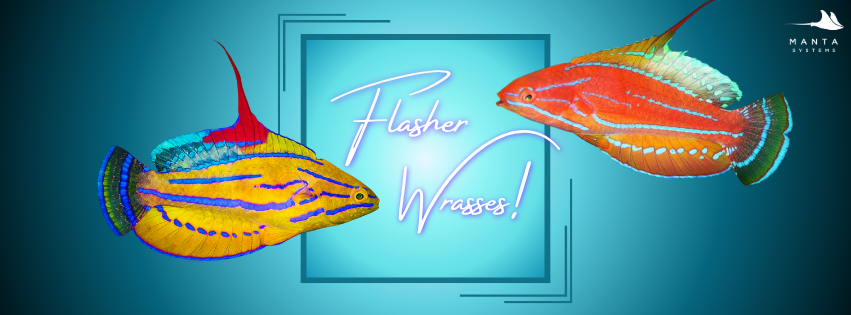

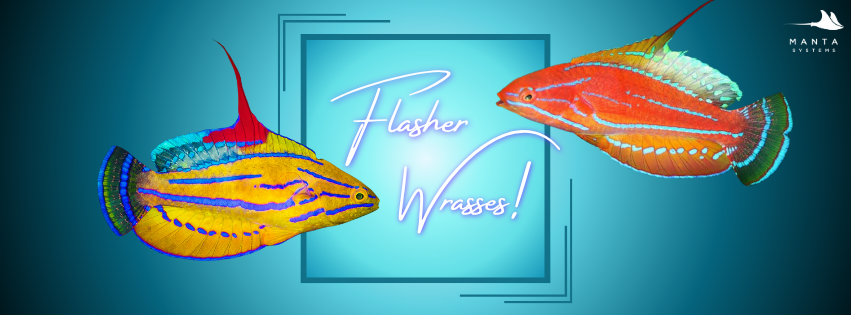
Flasher Wrasses (Paracheilinus): The Complete Species, Care, and Courtship Guide
As a reminder, I write these articles for fun and to help people learn and avoid the mistakes I made. If I missed something let me know and I can add it to the article.
-Tamara
Introduction
Let's start with the fish I found on my living room floor, dried out like a potato chip, four feet from the tank he'd lived in for exactly nine days.
That was my first flasher wrasse, and my introduction to a fact that every care sheet mentions in passing and nobody actually prepares you for. These fish don't jump occasionally. They jump like it's their job. I had a lid with a one-inch gap at the back for cords, the kind of gap that had housed a dozen other species without incident for years. It took my flasher wrasse nine days to find it.
That's the trade you're signing up for with this genus: color and display behavior that outclass almost anything else you can put in a reef tank, wired into a nervous system that treats a tapped glass or a flipped light switch as a five-alarm fire.
Flasher Wrasse or Fairy Wrasse?
Here's the Real Difference
Both groups are in the wrasse family, both are gorgeous, both do that electric fin-flaring courtship dance, and both get sold under vague names like "assorted fairy wrasse" by importers who clearly didn't want to do the paperwork.
On paper, the split comes down to size, temperament, and how badly each one wants to escape your tank:
|
Trait |
Flasher Wrasse (Paracheilinus) |
Fairy Wrasse (Cirrhilabrus) |
|---|---|---|
|
Typical size |
Smaller, usually 2–4 inches |
Wider range, 3–6+ inches |
|
Temperament |
Skittish, high-strung, easily startled |
Generally calmer, more outgoing over time |
|
Jumping risk |
Extremely high, especially early on |
High too,fairy wrasses are committed jumpers and need a secure lid just as much, but tend to be less frantic about finding a gap than flashers |
|
Dorsal fin display |
Erects into a tall, often elaborately colored sail during display |
Displays too, but less exaggerated fin elevation |
|
Display frequency |
Frequent, almost constant flashing in a happy harem |
Less constant, more situational |
|
Beginner friendliness |
Moderate, hardy once settled, but jumpy and shy at first |
Generally easier for a first-time wrasse keeper |
|
Genus size in the trade |
Roughly a dozen species commonly seen |
Dozens of species, huge color range |
The simplest tell in the store: watch how the fish reacts when someone taps the glass or a shadow passes over the tank. A flasher wrasse disappears into the rockwork like it's been shot at. A fairy wrasse tends to dart and recalculate. Neither reaction is wrong, it's just who they are, but it tells you a lot about what your tank needs to look like before the fish gets home.
Meet the Genus: Species Worth Knowing
Paracheilinus has roughly 20 recognized species, but only a handful show up in the trade with any regularity. Here are the ones I'd actually recommend a hobbyist go looking for, ranked roughly from easiest to most demanding.
|
Species |
Common Name |
Adult Size |
Difficulty |
Notes |
|---|---|---|---|---|
|
P. mccoskeri |
McCosker's Flasher Wrasse |
~3 in |
Beginner |
The most available and most forgiving. Good first flasher. Often Mistaken for a Carpenter's. |
|
P. carpenteri |
Carpenter's Flasher Wrasse |
~3 in |
Beginner |
About the same size as P. mccoskeri, among the smallest of the commonly traded species, calm disposition. Often Mistaken for a McCosker's. |
|
P. filamentosus |
Filamented Flasher Wrasse |
~5–6 in |
Beginner–Intermediate |
The largest commonly traded flasher wrasse, with a long trailing dorsal filament, one of the best display shows in the genus. |
|
P. flavianalis |
Yellowfin Flasher Wrasse |
~3 in |
Intermediate |
Gorgeous yellow accents, a bit shyer settling in. |
|
P. rubricaudalis |
Red-Finned Flasher Wrasse |
~3.5 in |
Intermediate |
Deeper-water origin, prefers dimmer lighting and won't love a blasting-bright reef tank. |
|
P. walton |
Walton's Flasher Wrasse |
~1.5–2 in |
Advanced |
One of the smallest species in the genus, extremely rare, expensive, and essentially unproven in long-term captivity. Not a first flasher. |
I want to be clear: within this genus, "beginner" is relative. Every single one of these fish needs a mature, well-established tank with a real rockscape to retreat into. None of them belong in a tank still cycling its second month. What "beginner" means here is more forgiving of feeding mistakes and more likely to settle in without becoming a permanent ghost, not "hardy like a clownfish."
Choosing by Tank Size
This is where most flasher wrasse mistakes actually begin, not in the ocean, not in the bag, but at the moment someone decides how many to buy for the tank they have.
|
Tank Size |
Recommended Setup |
|---|---|
|
40 gallons |
One male, kept alone, of a smaller species (P. mccoskeri, P. carpenteri) |
|
55–75 gallons |
One male with 2–3 females of the same species, forming a small harem |
|
90–125 gallons |
One male with 3–4 females, or multiple species kept together if visually distinct |
|
125+ gallons |
Multiple harems of different species, plus room for the flashing displays to actually happen without constant collision |
A single male alone will still color up and occasionally flash at his own reflection or at nothing in particular, but you're leaving the best part of owning this fish on the table. Flasher wrasses are harem spawners by nature, and the courtship display, which we'll get to in detail below, is dramatically more frequent and more spectacular when there's an actual audience of females to perform for.
Don't keep two males of the same species together in anything smaller than a very large system. They will fight, and unlike a lot of reef fish squabbles that resolve into an uneasy truce, flasher wrasse male rivalry can be relentless enough that one fish stops eating and eventually dies of stress rather than direct injury. If you want the full show, buy one male and multiple females of the same species, full stop.
Feeding: Small Mouths, Constant Eating
Flasher wrasses are planktivores. In the wild they hover over rubble and reef slopes picking zooplankton out of the water column pretty much nonstop during daylight hours, and that behavior doesn't turn off just because they're now living in your living room. Their mouths are small, their metabolisms are fast, and they will not thrive on one big feeding a day.
Two to four small feedings a day beats one large one. An empty stomach for too many hours is when a flasher wrasse starts looking thin and hollow-bellied, and that's a hole that's hard to dig back out of. For food itself, mysis (sometimes chopped depending on the size, Hikari has smaller mysis if needed) and enriched brine shrimp make a solid staple: small enough for that mouth, meaty enough to build real weight. Copepods and amphipods, whether from a mature refugium or dosed live, matter even more for shy feeders that haven't learned to trust prepared foods yet. Once a fish is established you can work in a quality pellet or flake, but don't expect a newly acquired flasher wrasse to accept dry food on day one, most need a few weeks of live and frozen foods before they'll even investigate a pellet. Once the take pellets use them in a mix and don't rely just on pellets to keep them going.
This is one of the few groups of fish where I genuinely think an auto feeder earns its keep, not as a luxury but as insurance. A flasher wrasse that misses a feeding because you worked late is a flasher wrasse running on empty by the next morning. It's part of why I built the R1 the way I did with small, frequent, scheduled feedings, which is exactly the rhythm this genus needs and exactly the rhythm that's easy to miss when life gets in the way.
Tankmates: Who Actually Gets Along
Flasher wrasses are peaceful, reef-safe, and genuinely low on anyone's threat list. That's good news for building a community tank around them, but it also means the burden of compatibility runs the other direction you need to protect them, not the other way around.
Good tankmates: gobies, blennies, and other small peaceful reef fish; clownfish (established pairs, not aggressive breeders guarding a territory the wrasse has to cross); other peaceful wrasse genera that don't overlap in color or shape; firefish and dartfish, which occupy a similar water column niche without competing directly.
Fish to avoid or be cautious with: large boisterous eaters like bigger tangs or aggressive damsels that will out-compete a flasher wrasse for food at every feeding; anything predatory enough to view a 2–4 inch fish as a snack; and other flasher or fairy wrasse species that share similar coloration. That last one is the one people miss, two visually similar wrasses, even from different genera, can trigger territorial aggression as if they were rivals of the same species. Stick to one showy wrasse "look" per tank unless the system is large enough to give everyone real separation.
The bigger risk to a flasher wrasse from tankmates usually isn't aggression, it's stress. A tank with a lot of fast, chaotic swimmers can keep a flasher wrasse hiding permanently, which defeats the entire point of keeping one. Build the community around calm, and the flasher wrasse will reward you by actually coming out to be seen.
The Jumping Problem (Yes, It's Really That Bad)
A few things trigger it: a sudden startle, a shadow, a knock on the glass, a light flicking on in a dark room. New tank stress, especially in the first two to four weeks after introduction. Male-on-male aggression, where a losing fish bolts and has nowhere to go but up. And nighttime disturbances, when a fish that would normally be tucked into a crevice gets spooked in the dark and panics.
What actually works: a tight-fitting mesh lid or full glass canopy with no gaps, not "mostly covered," fully covered. Cord holes, overflow boxes, and skimmer cutouts are exactly where these fish end up, so cover the overflow and sump specifically; an open overflow is basically a fish-sized funnel to the floor. Dim the lights gradually rather than snapping them on, especially in the first weeks after adding a new flasher wrasse a slow ramp gives the fish time to register the change instead of panicking. And keep sudden movement near the tank to a minimum during acclimation; this is not the fish to keep in a high-traffic hallway.
The Display: Courtship, Combat, and Changing Sex
The display is the reason people fall in love with flasher wrasses in the first place, and understanding what you're actually watching makes it a hundred times more interesting.
Flasher wrasses, like most wrasses, are protogynous hermaphrodites. Every fish starts life as a female. In a healthy harem, the largest and most dominant female eventually transitions into a male, a process driven by social structure, not chance. That male then holds his position through behavior and appearance, not just biology. If you remove the male from a tank, don't be surprised when, weeks later, the next-largest female in the group starts developing male coloration and taking over his role. It happens more often than new hobbyists expect, and it's one of the most fascinating things you can witness in a home reef tank.
The dominant male's job, once established, is to court and to warn, often within the same thirty seconds. During a flash display, he'll erect his dorsal fin fully upright, intensify his coloration until he looks like an entirely different fish, and dart in short, rapid bursts through the water column, usually looping back toward a cluster of females. It's a full-body performance, and it serves two audiences simultaneously: it says "choose me" to the females, and it says "this is my territory" to any rival male within sight.
This display peaks at dawn and dusk, which lines up with what I mentioned earlier about feeding schedules. If you want to actually witness it, don't expect the big show at high noon under blasting reef lighting. Catch your tank in that low-light window and, in a healthy harem, you'll see it most days.
A few behaviors worth knowing so you don't misread them: flashing at females is courtship, not chasing them off. It can look frantic, but it's the intended behavior. Flashing at a rival male is a warning, and it can escalate; watch for prolonged, aggressive posturing without a female audience, since that's more likely to turn into real conflict than a normal courtship display. And a dull, non-displaying male in an otherwise healthy harem is worth investigating. Loss of color and display frequency is often one of the earliest visible signs something is wrong, whether that's stress, illness, or a new dominance challenge underway.
Final Thoughts
Small and nervous is the price of admission with this genus, along with the near-certainty they'll eventually go testing the one gap in your lid you swore didn't exist. What you get in return is a display most reef keepers never see up close: a male working his harem in the low light of early morning, color switching on like something's been plugged in, while you stand there with a coffee at six a.m. watching a two-inch fish put on a better show than half the tank's expensive corals. Twenty-six years in, that's still what gets me down to the fish room before the coffee's finished brewing.


